If you are dreaming about mornings on the water near Bloomington, it is easy to assume any lakefront listing will deliver the same lifestyle. In reality, buying a lake home near Bloomington often comes down to details that are easy to miss, like dock rights, shoreline rules, septic systems, and recurring lake fees. If you know what to check before you make an offer, you can avoid surprises and focus on finding a property that truly fits how you want to live. Let’s dive in.
Lake Monroe and Lake Lemon work differently
If you are searching for a lake home near Bloomington, the first thing to understand is that Lake Monroe and Lake Lemon are not interchangeable markets. They may both offer water views and recreational appeal, but they operate under different rules and ownership conditions.
Lake Monroe is the larger lake, with 10,750 acres of water in summer, and it stretches mostly through Monroe County while also extending into Brown, Jackson, and Lawrence counties. It is a flood-control reservoir managed by the U.S. Army Corps of Engineers and Indiana DNR, which means water levels and shoreline conditions can shift after heavy rain as runoff is stored and later released.
Lake Lemon is smaller at 1,650 acres, with 24 miles of shoreline, and it sits about 10 miles northeast of Bloomington. It is managed by the Lake Lemon Conservancy District and also serves as Bloomington’s backup water supply, so local district rules and seasonal operations can affect how owners use the lake and access certain amenities.
For you as a buyer, that difference matters. Lake Monroe often involves reservoir-style shoreline management issues, while Lake Lemon involves district permits, local boating rules, and recurring use fees.
Dock rights can make or break value
A lakefront address does not always mean you can have the dock setup you want. This is one of the biggest issues to verify before you fall in love with a property.
Lake Monroe dock limits
On Lake Monroe, shoreline management rules play a major role in what owners can and cannot do. The U.S. Army Corps of Engineers says adjacent landowners may be eligible for licenses or permits only in certain shoreline zones, and protected shoreline areas cannot receive dock permits.
The rules are especially important because dock permits are limited to 11 dock sites already in place. In limited-development areas, only approved community docks and related improvements are allowed, which means a private dock may not be an option even if the home is on the water.
This is why some listings can honestly be marketed as lakefront while still offering no practical dock use. Before you buy, make sure you verify deeded rights, shoreline classification, and current permit status.
Lake Lemon structure approvals
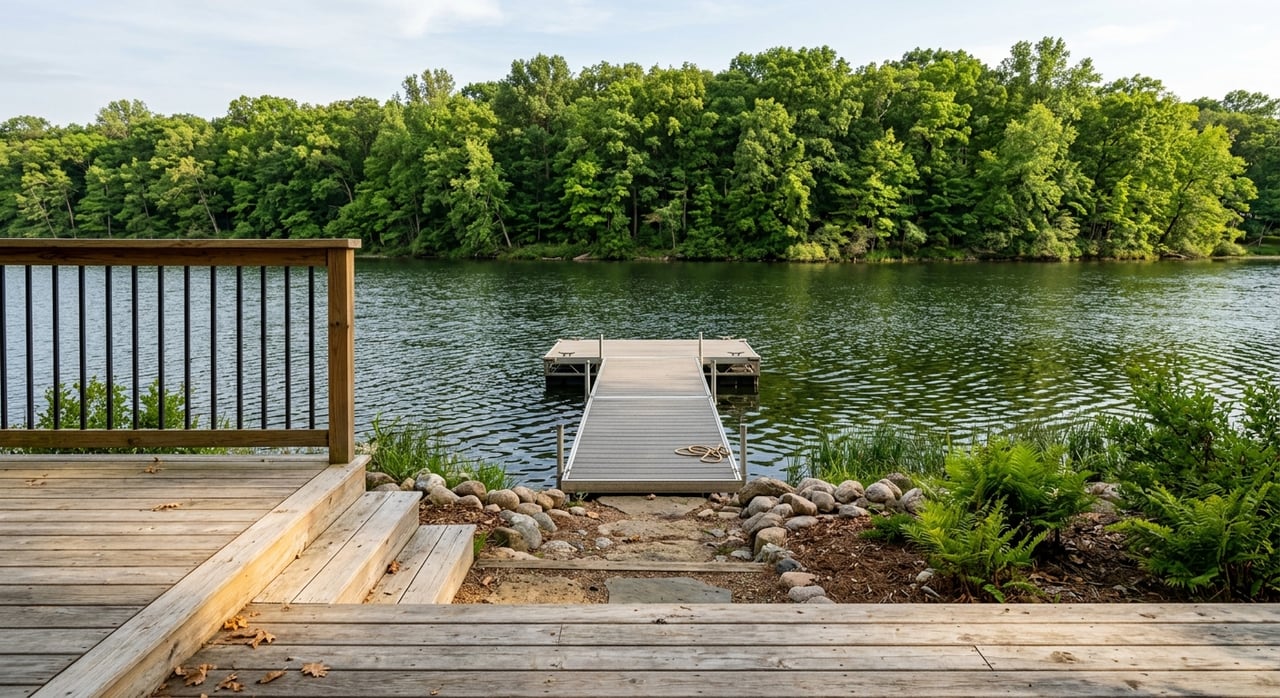
Lake Lemon also has dock and shoreline rules, but they work differently. According to the Lake Lemon Conservancy District, docks, piers, boat lifts, swimming rafts, mooring buoys, and similar structures within district boundaries must be approved before installation.
The district says these structures should be temporary or removable, should not extend more than 60 feet from shore unless approved, and may not use creosote-treated lumber. That means even if a property already has lake access, you still need to confirm whether the current setup is approved and whether any changes would need additional review.
Why this matters for your offer
Two homes with similar square footage can feel very different in value if one has usable water access and the other does not. Current local listing examples show exactly that, with some Lake Monroe listings noting no dock rights and some Lake Lemon listings noting an approved dock site.
If boating, fishing, or keeping your watercraft close to home is part of your plan, this should be one of the first items you investigate, not one of the last.
Lake fees and boating rules affect ownership costs
The purchase price is only part of your lake-home budget. Some properties also come with recurring lake-specific costs that can add up over time.
On Lake Lemon, all watercraft must be registered with the district and permitted before launching. The district also requires current state registration, a life jacket for each passenger, and limits watercraft length to 30 feet.
The current 2026 Lake Lemon fee schedule lists annual resident permits at $91 for boats with motors of 10 HP and over, $62 for boats under 10 HP, and $180 for personal watercraft. There is also a $42 annual ramp permit, along with daily launch and boat permit charges.
That does not mean Lake Lemon is less desirable. It simply means you should budget for lake use the same way you would budget for utilities, maintenance, or insurance.
Septic and well checks are essential
Many lake-area homes do not have the same utility setup you may be used to in town. That is why septic and private-well due diligence should be a standard part of your buying process.
Septic questions to ask
The Monroe County Health Department says septic permits are required for new construction, repairs or replacements, and permit renewals or modifications. It also says soil reports are required when modifying or adding a septic field.
For you, that means a basic home inspection is not enough if the property uses septic. You will want to review the system’s age, permit history, pumping records, and whether replacement or expansion would be feasible if needed.
Well testing and location
The Indiana Department of Health recommends annual testing of private wells for bacteria and nitrate. It also recommends testing for fluoride, arsenic, lead, and copper at least every five years or when major maintenance is completed.
The state also says private wells should be located where they can be maintained in sanitary condition, protected from flooding or ponding, and accessible for service. Near a lake, that makes location and maintenance history especially important.
Utility records to request
When you are serious about a lake property, ask for:
- Septic permits and repair history
- Pumping and maintenance records
- Well logs
- Pump age
- Water treatment system history
- Confirmation of whether the property uses private systems or public utilities
This type of paperwork can tell you a lot about future costs and possible limitations.
Lake-home pricing is not like in-town Bloomington
One of the biggest mistakes buyers make is assuming lake-home pricing follows the same pattern as the rest of the Bloomington market. It often does not.
Zillow reports an average Bloomington home value of $315,221 as of April 30, 2026. Realtor.com reports a March 2026 median listing price of $385,000. Those numbers are useful as a baseline, but lake properties can vary much more widely depending on access, utility, and shoreline rights.
Current listing examples show that range clearly. Lake Monroe search results include properties from a $243,000 condo with lake-access features up to listings at $699,200, $1.424 million, and $1.711 million.
Lake Lemon listings show a broad spread too, from a $107,000 lot to homes listed at $224,000, $324,900, $399,999, $429,000, $650,000, $749,000, and $974,999. That spread tells you something important: lake value is highly property-specific.
What drives lake-home value
Near Bloomington, price often depends on details such as:
- Waterfront versus lake view
- Dock rights or approved dock sites
- Shoreline classification
- Acreage and privacy
- Condo access versus direct access
- Septic and well setup
- Seasonal access or operating limitations
A home that looks affordable compared with other waterfront listings may be priced that way for a reason. On the other hand, a condo or home without dock rights may offer the lake lifestyle you want at a much more approachable price point.
Questions to answer before you buy
If you want to shop smarter, focus on function first. A lake home should work the way you expect it to work.
Before making an offer, ask these questions:
- Can you legally keep, replace, or add a dock?
- How is the shoreline classified?
- Does the property have deeded lake access or only a view?
- Are there district permits, ramp fees, or boating costs you will pay every year?
- Does the home rely on septic, a private well, or both?
- Are there records showing those systems were permitted and maintained?
- Could seasonal operations affect access, shoreline conditions, or nearby amenities?
These answers can shape both your budget and your day-to-day enjoyment of the property.
Why local guidance matters
Lake properties near Bloomington ask you to evaluate more than bedrooms, bathrooms, and price per square foot. You are also buying into a set of shoreline rules, utility conditions, and access realities that can differ dramatically from one parcel to the next.
That is why local, property-level guidance matters so much in this niche market. When you look closely at the right details early, you can move forward with confidence and avoid paying lake-home prices for a property that does not deliver the lake-home lifestyle you want.
If you are considering a lake home near Bloomington, Amanda Richardson can help you sort through the details, compare properties carefully, and find the right fit for your goals.
FAQs
What should you verify before buying a lake home near Bloomington?
- You should verify dock rights, shoreline classification, permit status, utility setup, and any recurring lake-specific fees before making an offer.
How is Lake Monroe different from Lake Lemon for buyers?
- Lake Monroe is a larger flood-control reservoir with shoreline management rules, while Lake Lemon is governed by a conservancy district with its own permits, boating rules, and fee structure.
Can a lakefront home near Bloomington have no dock rights?
- Yes. Some lakefront properties, especially around Lake Monroe, may not include dock rights because of shoreline classification or permit restrictions.
What utility issues matter for lake homes in Monroe County?
- Septic systems and private wells are key issues because buyers should review permits, maintenance records, testing history, and whether replacement or servicing may be needed.
Why do lake homes near Bloomington vary so much in price?
- Prices can vary based on direct water access, approved dock sites, shoreline restrictions, acreage, utility setup, and whether the property is true waterfront, lake access, or lake view only.