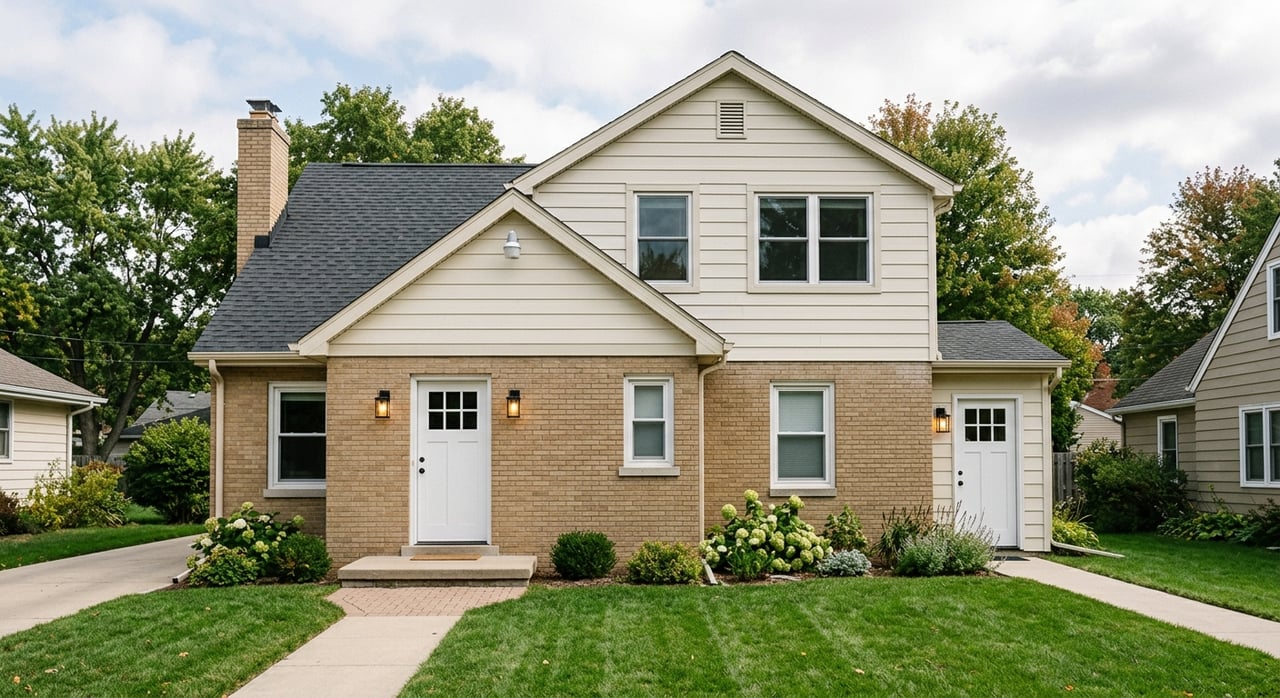
Thinking about buying a home in Bloomington and letting part of it help pay the bills? In a market where renting is common and home prices are not exactly cheap, house hacking can be a smart way to lower your monthly housing cost without waiting years to become an investor. If you want to know what works in Bloomington, what to double-check before you buy, and how to spot a property with real potential, you are in the right place. Let’s dive in.
Why house hacking fits Bloomington
Bloomington is a renter-heavy housing market, which is part of what makes house hacking so appealing here. Census QuickFacts reports an owner-occupied housing rate of 34.7% in Bloomington, along with a median owner-occupied home value of $321,400 and median gross rent of $1,200 for 2020 through 2024.
More recent market snapshots also show the same basic pattern. Redfin reported a median sale price of $340,000 for Bloomington over the three months ending May 2026, while Zillow listed average rent at $1,411 as of May 31, 2026. That means rental demand may support a shared housing setup, but purchase prices still require careful math.
The big local takeaway is simple: in Bloomington, house hacking usually works best as a strategy to reduce your own housing expense. It is less reliable as a pure high-cash-flow play, especially if you are stretching your budget to buy.
What house hacking can look like
House hacking just means living in a property while renting out part of it. In Bloomington, that can take a few different forms, and each one comes with its own rules.
Duplexes to fourplexes
A duplex, triplex, or fourplex is often the cleanest setup for house hacking. You live in one unit and rent the others, which gives you clearer separation between your space and your tenants’ space.
Bloomington’s Unified Development Ordinance recognizes duplex, triplex, and fourplex dwelling types. Parking rules can vary by district and unit count, so the property still needs a close review, but small multifamily can be one of the most straightforward paths when the zoning and parking standards line up.
Accessory dwelling units
An accessory dwelling unit, or ADU, is a smaller independent home on the same lot as a larger primary home. In Bloomington, city materials describe ADUs as a way to create rental income or meet family needs.
Local rules matter here. Bloomington allows only one ADU per lot, requires either the primary dwelling or the ADU to be owner-occupied, and says any primary dwelling or ADU used as a rental must register with HAND before occupancy. The code also says ADUs must connect to adjacent public water and sanitary sewer.
Renting rooms in a single-family home
This is the version many buyers picture first. You buy a house, live in one bedroom, and rent the others to help offset your mortgage and other monthly costs.
That can work, but occupancy limits are a major factor in Bloomington. In most residential areas, the limit is three unrelated adults, while some multi-dwelling zones allow up to five adults. Before you treat room rentals as part of your budget, you need to confirm the legal occupancy standard for that specific property.
Bloomington rules to check first
A house hack is only as strong as its legal setup. Before you get attached to a property, you need to understand whether the intended use is actually allowed.
City limits versus county limits
This is one of the first questions to answer. A property inside Bloomington city limits may be subject to different rules than a property in unincorporated Monroe County.
Inside city limits, rental use is governed by Bloomington’s Residential Rental and Lodging Establishment Inspection Program. The city states that no occupancy permit is issued until the unit and premises have been inspected and code requirements are met, and Bloomington added an occupancy affidavit in 2021 for rental properties containing four or fewer units.
Outside city limits, Monroe County planning and zoning rules come from the county development ordinance and planning department rather than the city code. The Monroe County Health Department says it does not have a local rental housing code and mainly serves as a referral source, which makes the city-versus-county boundary a key due diligence step.
Occupancy and permits
If your strategy involves renting a unit, an ADU, or rooms within a home, you need to verify the paperwork as carefully as you verify the roof or foundation. A property may look perfect on paper but still have missing permits, outdated approvals, or occupancy issues.
For Bloomington properties, it is smart to confirm whether permits, inspections, occupancy paperwork, and any required registration are already in place. If they are not, you need to understand the timeline and cost to bring the property into compliance.
Historic district review
Older homes can be appealing for house hacking, especially if they have flexible layouts, basement space, or room for an addition. But if a property sits in a historic district, exterior changes or new construction may require a certificate of appropriateness.
That matters if you are considering a basement conversion, rear addition, or detached cottage. In those cases, both zoning review and preservation review may come into play before you can move forward.
Utility and property constraints
Some house-hack ideas sound easy until the infrastructure says otherwise. An ADU, for example, must connect to adjacent public water and sanitary sewer under Bloomington’s code.
You may also need to look into parking, lot layout, HOA rules if they apply, and whether the property’s existing setup matches the use you have in mind. The more changes you need to make, the more important your up-front due diligence becomes.
How to evaluate a Bloomington house hack
The best house hack is not always the one with the highest possible rent. In Bloomington, a better test is whether the property still feels manageable if income comes in lower than expected or a room sits vacant for a while.
A practical screen is to compare estimated monthly rent against your full monthly housing cost after accounting for vacancy, utilities, repairs, insurance, taxes, HOA dues, and capital reserves. This gives you a more realistic picture than looking at gross rent alone.
Based on current Bloomington benchmarks, $1,200 per month on a $340,000 purchase equals a gross yield of about 4.24%. At $1,411 per month, the gross yield is about 4.98%, before financing and operating expenses. Those numbers support a cautious approach rather than a hype-driven one.
Stress test your numbers
One of the smartest ways to analyze a house hack in Bloomington is to run the numbers conservatively. Ask yourself whether the property still works if one room or one unit is vacant for a period of time.
If the answer is yes, the setup may be more resilient. If the deal only works at full occupancy with very little room for repairs or turnover, it may carry more risk than you want.
Focus on cost reduction first
In some markets, buyers chase house hacking for aggressive cash flow. Bloomington’s rent-to-price relationship suggests a different mindset.
Here, the stronger goal is often lowering your personal housing cost while building equity and gaining flexibility over time. If the property also performs well as a long-term investment, that is a bonus, not something you should assume from day one.
What to ask before you make an offer
When you find a property that seems promising, slow down and ask targeted questions. A little extra research before you buy can save you from an expensive surprise later.
Start with these:
- Is the property inside Bloomington city limits or in unincorporated Monroe County?
- Is the rental plan based on a legal unit, an ADU, or just a bedroom arrangement?
- Will the property stay within Bloomington occupancy limits after the rental is added?
- Are permits, inspections, rental registration, and occupancy paperwork already complete?
- Would the property need historic-district review, HOA approval, parking changes, or utility upgrades?
These questions help you move from a general idea to a real-world decision. They also make it easier to compare one property against another when more than one option is on the table.
Why local guidance matters
House hacking sounds simple until you get into zoning, occupancy limits, city boundaries, and property-specific details. In Bloomington and Monroe County, those details can change the value of a deal fast.
That is why local guidance matters so much. When you work with someone who understands Bloomington’s housing stock, city-versus-county differences, and the practical questions behind small investment properties, you can shop with more confidence and fewer surprises.
If you are exploring house hacking in Bloomington and want help identifying properties that fit your goals, Amanda Richardson can help you evaluate options with a local, practical lens.
FAQs
What is house hacking in Bloomington, Indiana?
- House hacking in Bloomington means you live in a property while renting out part of it, such as another unit, an ADU, or bedrooms, to help reduce your monthly housing cost.
Are room rentals allowed for house hacking in Bloomington?
- Room rentals may be allowed, but Bloomington occupancy limits are a key factor. In most residential areas, the limit is three unrelated adults, while some multi-dwelling zones allow up to five adults.
Can you build or rent out an ADU in Bloomington?
- Bloomington allows one ADU per lot, requires either the main home or the ADU to be owner-occupied, and requires rental registration with HAND before occupancy if the primary dwelling or ADU is used as a rental.
Do Bloomington rental properties need inspections or permits?
- Inside Bloomington city limits, rental use falls under the city’s Residential Rental and Lodging Establishment Inspection Program, and the city says no occupancy permit is issued until the unit and premises have been inspected and code requirements are met.
Is house hacking different in Monroe County outside Bloomington?
- Yes. Outside Bloomington city limits, planning and zoning rules come from Monroe County’s development ordinance and planning department rather than Bloomington city code.
Is house hacking in Bloomington a good cash-flow strategy?
- It can help lower your housing costs, but local rent and price benchmarks suggest you should view it more as a cost-reduction strategy than a guaranteed high-cash-flow investment.